
Co-Ownership
Co-ownership insurance is a complex field. To understand it well, you must take every opportunity to further your knowledge. The sources of information on co-ownership in the links, documents and tools below will better equip you to advise your clients, help them choose the right products and support them when making a claim.
The information on this page applies to divided co-ownerships.

Before accepting a co-ownership insurance mandate, agents, brokers, and claims adjusters must make sure they have the skills and knowledge to properly advise their clients[1] and effectively handle their files, from quotation to claim. This article provides useful information to help you improve your skills.
Description of private portions / reference unit
Under section 1070 of the Civil Code of Québec, the syndicate of co-owners must maintain a register accessible to co-owners that includes, among other things, a sufficiently detailed description of each private portion (the reference unit).
It is not your responsibility to write up a description of the private portions. For newly built condominiums, the description is provided to the syndicate of co-owners by the developer. This description is, however, one of the documents you will need to accurately evaluate your clients’ needs and advise them properly.
You can suggest your clients use the Insurance Bureau of Canada’s (IBC) model to help them do this.
Mandatory for all co-ownerships since 2018
The description of the private areas has been mandatory for all divided co-ownerships since 2018. For co-ownerships built before 2018, the syndicate should also already have included the description of the private areas in the register, as the deadline for doing so was December 13, 2020. If the syndicate is not compliant in this respect, explain that this description is one of the documents you need to properly assess your client’s needs and provide appropriate advice.
Its purpose
The description allows you to identify improvements the co-owners have made over the years, and in the event of a loss, it helps avoid any confusion over what the syndicate’s insurance covers (all immovable property, including private portions as they were originally built) and what constitutes an improvement to private portions (covered by the co-owner’s insurance).
A co-owner’s insurance policy, which is often mandatory under the declaration of co-ownership, covers any improvements made to the private area compared with its original condition. Keep in mind that the original condition is the condition of the unit at the time the declaration of co-ownership was published, not at the time your client purchased the property. Therefore, improvements made by previous owners must also be taken into account when determining the amount of coverage required.
Important
As damage insurance agents and brokers, you should ask your clients (be they syndicates or co-owners) for a copy of this description to help you properly evaluate or re-evaluate their needs and the coverages required.
As claims adjusters, you should also ask for a copy of the description of the private portions (or the description of the reference unit) to identify any improvements the co-owners have made that have increased the unit’s value.
This document is one of the records required when handling a co-ownership insurance claim. For more information, consult the tip sheet on this topic.
Insurance, coverage and cost of rebuilding
According to section 1073 of the Civil Code of Québec, the syndicate must purchase insurance for the entire building, including the private areas. It must maintain adequate insurance coverage against common risks and provide for a reasonable deductible. This insurance covers the building as a whole but excludes any improvements made by co-owners to their private areas. The amount of coverage must be sufficient to allow for the complete reconstruction of the building.
Evaluation of the cost of rebuilding the co-ownership every five years
At least every five years, the syndicate of co-owners must mandate a member of the Ordre des évaluateurs agréés du Québec[2] to carry out an evaluation of the building’s reconstruction cost. The declaration of co-ownership may require that this evaluation be conducted more frequently. The Ordre des évaluateurs agréés du Québec, in collaboration with the IBC and the Chambre de l’assurance, has revised the list of elements to include when conducting an evaluation for insurance purposes mandated by the syndicate of co-owners [in French only]. Ask the syndicate for a copy of this evaluation. If you notice that certain elements are missing, discuss this with the syndicate’s representatives, and explain to them the legal requirements and potential impacts on the syndicate’s insurance so that it can make an informed decision, such as requesting an adjustment to the evaluation.
Important
You can explain to your client that the value of reconstruction corresponds to the cost of rebuilding the entire building, including demolition costs, landscaping, bringing everything up to code, professional fees, labour costs, and taxes. Make sure to stress the importance of proper coverage in the event of a major loss. You can also explain to your client the coinsurance clause, which would apply in the event of a partial loss. And finally, remind your client that an insurer could refuse to insure the risk if it finds that the syndicate does not plan to purchase insurance to cover the full cost of reconstruction.
Agents and brokers: ask for a copy of the evaluation report and advise your client appropriately by making recommendations based on the evaluation.
Claims adjusters: the evaluation report on the cost of rebuilding the property could contain valuable information on the category of the building, the quality and type of materials used and other information regarding the building’s construction; ask for a copy.
Mandatory coverages for the syndicate of co-owners
Risks
The Regulation to establish various measures in matters of divided co-ownership insurance stipulates that the syndicate’s property insurance contract must include the following risks if they are not excluded under the insurance policy: theft, fire, lightning, storms, hail, explosions, water leak damage, sewer backup and overflows from appliances connected to water distribution piping within the building, strikes, riots or civil disturbances, the impact of an aircraft or vehicle, and vandalism or malicious acts.
Condominium Directors’ Liability
The syndicate must also purchase liability insurance covering its own liability, as well as that of the directors, the manager, and the officers of the meeting of co-owners with respect to third parties (which, in this context, primarily refers to the co-owners themselves)[3].
Important
Agents and brokers: verify and, if need be, suggest adjustments to the coverages included in the contracts of your syndicate of co-owners clients.
Co-owners insurance
Each co-owner must take out liability insurance for at least one million dollars if the immovable has fewer than 13 fractions and two million dollars if it has 13 or more fractions.4
Co-owners may always purchase an insurance policy covering the entirety of their private area, rather than only the improvements made to it. In such cases, this coverage may overlap with the insurance maintained by the syndicate. When a co-owner obtains insurance for a risk that is already covered by the syndicate’s policy, the syndicate’s insurance acts as the primary insurance coverage.[5]
Any amounts assumed by the syndicate to repair damages must then be divided (apportioned) among the co-owners, in particular when the repairs are inadmissible under the terms of the contract (absence of insurance or insufficient insurance) or if the syndicate has chosen not to file a claim for the loss.
Co-owners may also purchase insurance to protect themselves against insufficient insurance coverage maintained by the syndicate. In such cases, the portion of the loss allocated among the co-owners that results from a lack of insurance or inadequate coverage may be recovered by the insured co-owner, even if their unit has not sustained any damage. However, deductibles under the syndicate’s insurance policy are generally not covered by this type of insurance.
Important
You play an important part in informing insureds of the risks they are exposed to, as well as the available coverages, mandatory coverages, the exclusions and the limits. To be able to advise your clients appropriately, you must start by asking questions that allow you to understand their needs.Furthermore, if an insured refuses an endorsement, it is your responsibility to explain to him the consequences of this decision and to note your file accordingly.
The Syndicate of Co-owners’ Deductibles: Your Advisory Role
As you are aware, the deductible can significantly impact the cost of your client’s insurance premium. If you have little leeway for negotiating the amount of the deductibles stipulated in your client’s contract, here are four crucial points to keep in mind when a syndicate of co-owners purchases or renews its insurance contract.
1. The claims history has an impact on the deductible amounts; encourage the syndicate to raise awareness of co-owners about the importance of properly maintaining their building and their units. Suggest a list of preventive measures to reduce the risk of damages, in particular water damage.
2. Syndicates must now have a self-insurance fund. Explain to your client that the higher the deductibles in their contracts, the higher the amount that will need to be invested in the self-insurance fund.
3. The amount of the deductible is a common expense that is apportioned among all the co-owners according to their share (with some exceptions, for instance where damages are caused by a co-owner’s negligence and the syndicate chooses to claim damages from them). To verify whether the deductible is reasonable, divide it by the number of units; this will provide an estimate of the amount that each unit would be required to assume and will allow you to see how it compares to the amount that a home insurance client would normally assume as a deductible (approximately $500 to $1,000).
4. Do not forget to keep detailed notes of your discussions with the syndicate’s directors so that you have a record of what was discussed. This will allow you to document your compliance with your ethical obligations and protect your professional liability.
To find out more, read: An Overview of Deductibles for Syndicates of Co-ownership.
The Self-insurance Fund
The syndicate has an obligation to create a liquid, available on short notice, self-insurance fund [7] [article in French only] that is used to pay deductibles and repair syndicate property when the contingency fund or money from an insurance claim cannot do so.
This fund must be able to cover the highest deductible in the syndicate’s insurance contract, except for the deductible for earthquakes and flood coverage, if such coverage is included in the contract.[8]
If the syndicate has used the fund to pay an insurance deductible during the year, it must make provisions to replenish the fund through its next budget.
Calculating the Amount
When drawing up the annual budget, the syndicate determines the co-owners’ contributions to the self-insurance fund and the contingency fund, and sets the common expenses.
As explained by the Regroupement des gestionnaires et copropriétaires du Québec (RGCQ), the calculation of the amount to be paid into the self-insurance fund depends on two factors:
- The amount already accumulated in the fund
- The amount of the highest deductible specified in the association’s insurance policies
“The logic is quite simple: you contribute at least half of the highest deductible when the fund is underfunded, then make up the difference to reach the deductible amount. Once this amount is reached, there is no longer a minimum contribution to be paid,” states the RGCQ.”
Here is an example that illustrates the rule in practice.
Highest deductible in the policy (excluding those for earthquakes and floods): $100,000
Amount in the self-insurance fund at the start of the budget reference year: $0
Minimum annual contribution (half of the deductible): $50,000
In this specific example, the union must plan to build up the fund over two years.
Other examples:
- If the fund contains more than $50,000 but less than $100,000, the shortfall must be contributed over the course of one year to reach the exemption amount. For example, if the fund contains $75,000, the minimum contribution will be $25,000
- If the fund contains exactly $50,000, the minimum annual contribution remains $50,000, since the first rule applies as long as the fund does not exceed half of the exemption amount. The fund will therefore go directly from $50,000 to $100,000 in a single budget.
| Amount held in the self-insurance fund | Amount to contribute during the fiscal year |
|---|---|
| 50% or less of the highest deductible* | 50% of the highest deductible |
| Over 50% of the highest deductible* | Difference between the fund’s capitalization and the amount of the highest deductible |
| Equal or higher than the highest deductible* | No obligation to contribute |
Despite the above, the syndicate may decide to limit the self-insurance fund to an amount of 100 000$ [9] and only contribute accordingly.
Make sure your clients are aware of the amount of the deductible that determines their minimal contribution to the self-insurance fund.
Maintenance Log and Contingency Fund
Sections 1070.2 and 1071 of the Civil Code of Québec require the syndicate of co-owners to have a maintenance log and a review of the contingency fund prepared by a professional at least once every 5 years.
The maintenance log is prepared by a specialist duly authorized under the Regulation establishing various rules concerning divided co-ownership. Among other things, it sets out a 25-year schedule of major repairs and replacements to be carried out on the parts, materials, appliances, and equipment under the syndicate’s responsibility.
The review of the contingency fund, conducted by a professional, is based on the maintenance log. It demonstrates the syndicate’s financial capacity to maintain the building’s common areas for the next 25 years, and the annual contribution of the co-owners to the contingency fund is determined based on this review.
To learn more about the maintenance log and the contingency fund, as well as how they relate to your professional practice, see the article Co-ownership: maintenance log, syndicate certificate and your advisory role.
Syndicate’s Certificate
The certificate provides an overview of the building’s condition and the financial, insurance, legal, and administrative status of the co-owners’ syndicate. It must be provided within 15 days upon request by a co-owner and solely for the purposes of a real estate transaction. It is mandatory under Section 1068.1 of the Civil Code of Québec.
It contains, among other things, the following information:
Elle contient entre autres les renseignements suivants :
- The amounts of the contingency and self-insurance funds;
- The amount of the highest deductible provided for in the insurance contract;
- A summary description of:
- claims involving the private unit being sold or the common areas over the past five years;
- ongoing disputes that are the subject of court proceedings in which the homeowners’ association is a party;
- inspections or appraisals conducted at the co-owners’ syndicate’s initiative over the past five years that addressed the general condition of the building or one of its major components;
- major repairs and replacements carried out on the common areas, along with their costs over the past five years and those planned for the next 10 years.
To learn more about the syndicate certificate and why it can be useful in your professional practice, read the article Co-ownership: maintenance log, syndicate certificate and your advisory role.
Whether or not to claim (and the obligation to report)
Even if a loss is covered by the syndicate’s insurance contract, for various reasons (amount of damages close to the deductible, multiple claims, etc.), some syndicates may choose not to file a claim for compensation with their insurer.
The syndicate’s board of directors might contact you, their agent or broker, to find out whether they should file a claim or not. At that point, you can explain to the syndicate what its obligations are, as well as the pros and cons of each option.
Whether or not the syndicate decides to submit a claim, it must notify its insurer as soon as it becomes aware of the loss, provided it may fall within the scope of the coverage under its insurance policy[10].
If, however, the syndicate decides not to file a claim for a loss that falls within its coverage, it must ensure that the damage caused to the property is repaired.[11] The syndicate will thus have to have the repairs done, except for those related to improvements to private portions. Furthermore, the repair costs incurred by the syndicate will then have to be apportioned among all the co-owners, as a common expense, according to their share.[12] See “Bringing an action against a co-owner” below to learn more about actions the syndicate can bring against a co-owner who is deemed liable for the damages.
When a loss occurs: the adjuster’s role
Even if water damage occurs in only one of a building’s 15 units, the claim must be made under the syndicate’s insurance.[13] Claims adjusters must therefore understand the rules surrounding claims in divided co-ownership in order for them to properly inform all the parties involved in the settlement.
In particular, the claims adjuster must act quickly to investigate the claim, identify its cause and origin, assess the extent of the damage and identify the parties involved in order to properly apply the rules governing divided co-ownership..
The Chambre has created a Tip sheet on co-ownership to help claims adjusters fully meet their ethical obligations.
Bringing an action against a co-owner?
Can the syndicate demand that a co-owner who has been deemed liable for damages reimburse it for the amount it paid to repair the damages?
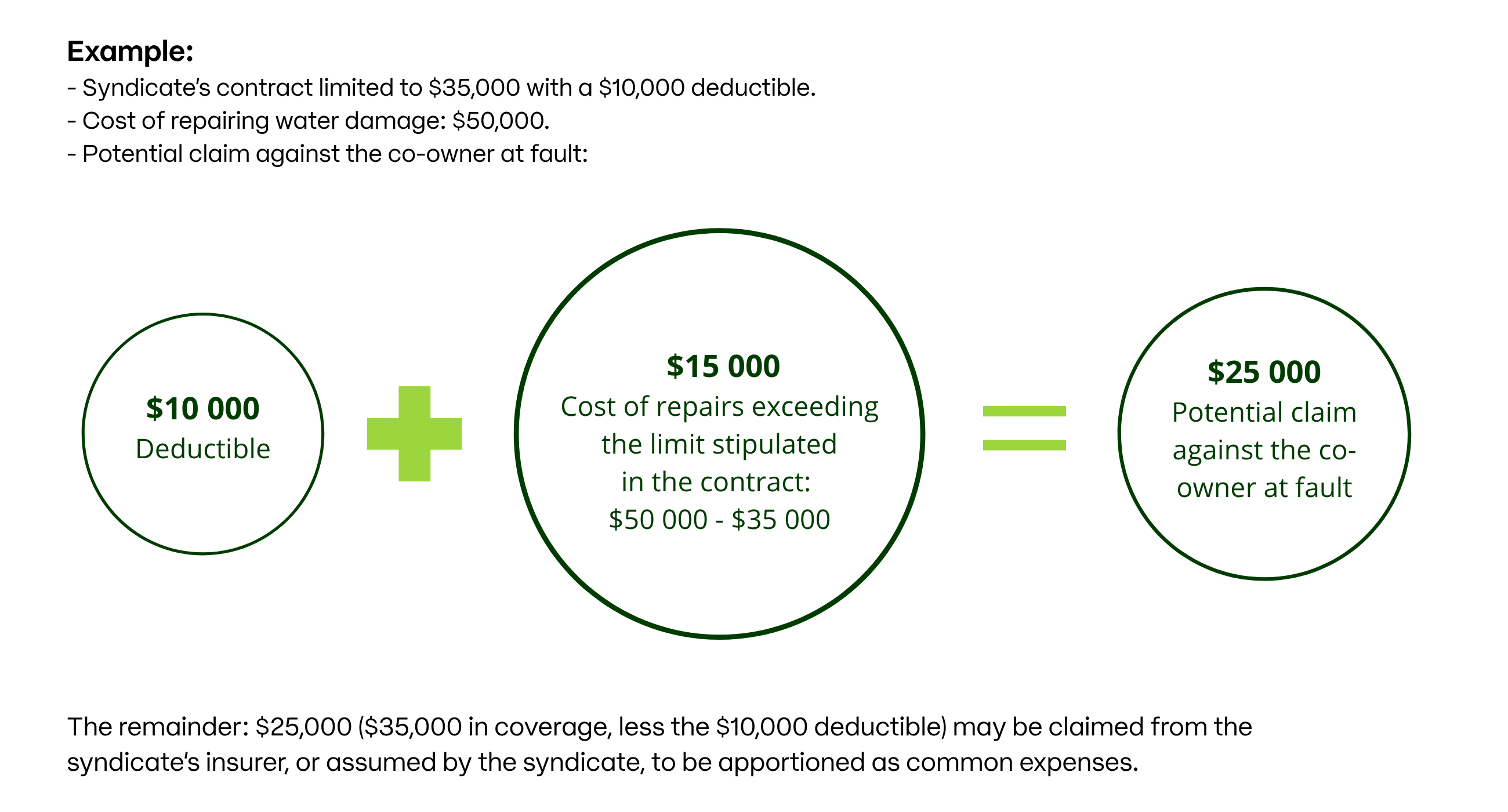
The syndicate may only claim damages from a co-owner resulting from the co-owner’s negligence, particularly with regard to the deductible amount or the portion of the damages that exceeds or is not covered by the insurance policy.
Under such circumstances, the co-owner would be obliged to make reparation for the injury caused by the co-owner’s fault or by the fault of another person (for example, their child) or by the act of things in the co-owner’s custody (for example, an appliance), in accordance with the declaration of co-ownership.[14]
The same applies to an insurer’s right of subrogation: they may not be subrogated to the rights of any of the following persons to proceed against another:
- the syndicate,
- a co-owner,
- a person who is a member of the co-owner’s household (which does not include a tenant), or
- a person in respect of whom the syndicate is required to obtain liability insurance cover (directors, the manager, the chairs of the general meeting of co-owners).[15]
In practice, even when a co-owner or another relevant party is liable for damage, the insurer generally cannot exercise a right of subrogation against that party. This limitation applies to the insurer and should not be confused with the remedies that the co-ownership syndicate itself may exercise in situations provided for by law and the declaration of co-ownership.
The law does, however, provide for exceptions when the damage is physical or emotional, or when it results from willful misconduct or gross negligence.
Claims adjusters must act fairly and objectively in their investigation. Their role is to gather, analyze, and document all relevant facts surrounding the claim.
When the investigation reveals evidence that may indicate gross negligence or intentional misconduct, such evidence must be adequately documented in the file to support the analysis of the claim and, if necessary, the pursuit of remedies provided for by law.
 Please feel free to contact the Chamber of Insurance at info@chambreassurance.ca with any questions regarding your professional practice.
[1] Section 17 of the Code of ethics of damage insurance representatives and section 26 of the Code of ethics of claims adjusters.
[2] Section 3 Regulation to establish various measures in matters of divided co-ownership insurance.
[3] Article 1073 of the Civil Code of Québec.
[4] Section 1 Regulation to establish various measures in matters of divided co-ownership insurance.
[5] Article 1074.3 of the Civil Code of Québec.
[6] Article 1071.1 of the Civil Code of Québec.
[7] Section 2 of the Regulation to establish various measures in matters of divided co-ownership insurance.
[8] Section 2 of the Regulation to establish various measures in matters of divided co-ownership insurance.
[9] Section 2470 of the Civil Code of Québec.
[10] Article 1074.1 of the Civil Code of Québec.
[11] Article 1074.2 of the Civil Code of Québec.
[12] Article 1073 of the Civil Code of Québec.